

The Full Price
On Loyalty, Betrayal, and the People Who Were Never Paying What You Were

INITIATING_TRANSMISSION
AUTHOR: Profit
ORIGIN: Retrograde
CURRENT_LOCATION: Tijuana, Baja California, MX, Earth-473B
STATUS: Operational
CLASSIFICATION: SYSTEMS_AUDIT // LOYALTY // PSYCHOLOGY_OF_BETRAYAL
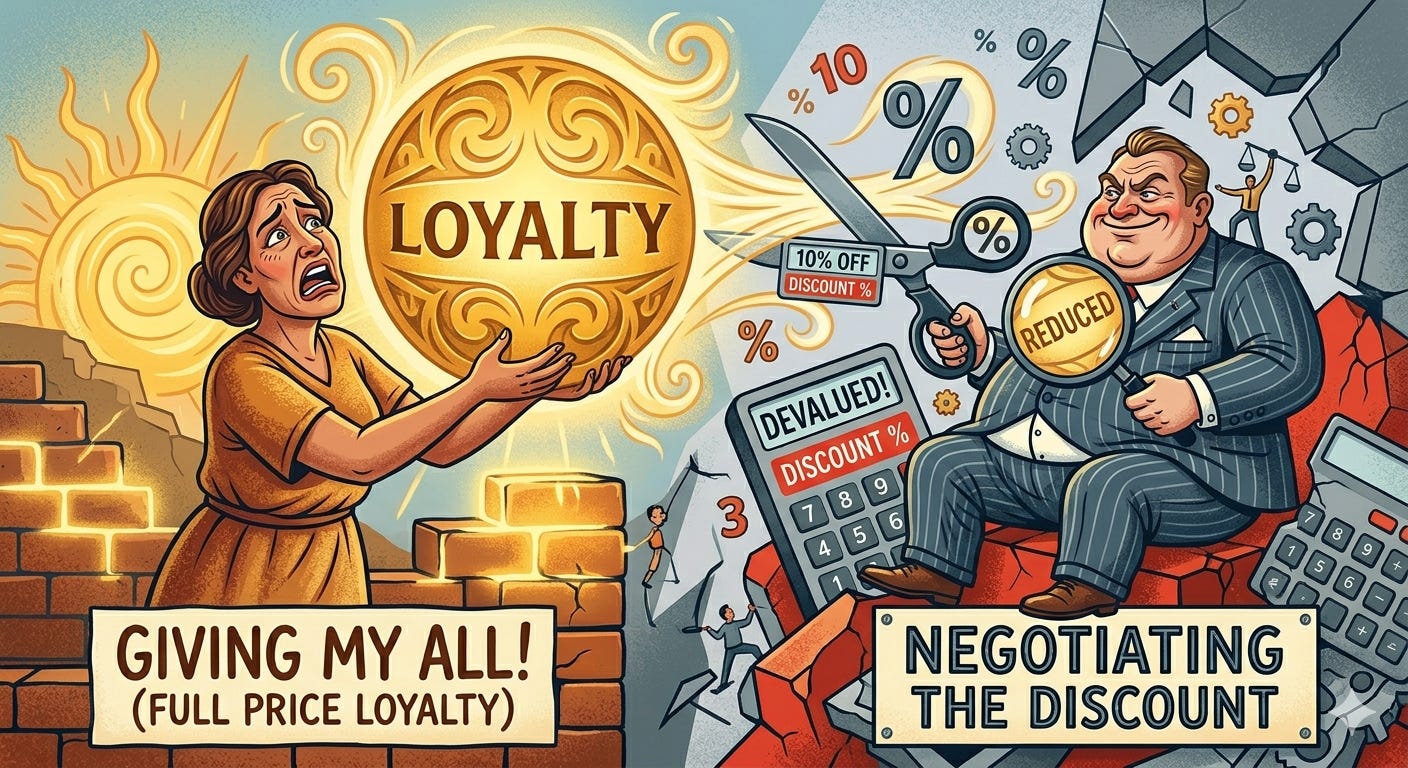
Loyalty is one of the few things people give at full price while the other side is already negotiating the discount.
You’re never told this up front. You find out later, usually in a spot that used to feel safe, usually from someone who had your back until it became inconvenient. What’s worse is they never announce it. They just gradually stop showing up and call it growth.
Here is my piece.
//THE_SETUP
Is there such a thing as mutual loyalty? I would have to say no.
I know that sounds wrong, you probably want to push back. You’re thinking about the people in your life who have never wavered, the ones who showed up at 3AM, who never asked what you needed because they already knew. Those people exist. I have a few of them. They’re real.
But they’re the variable inside a system that isn’t designed for them.
Loyalty, as most people practice it, is unequally distributed by default. One person in every relationship always has more of it. One is always holding the door open a little longer than the other one would, and is always absorbing more of the cost of staying connected. Since nobody audits this in real time, because loyalty doesn’t come with a dashboard or a ledger, the imbalance runs for years before anyone names it.
By the time you do, you’ve already paid everything.
The system doesn’t tell you this because it benefits from you staying loyal to things that aren’t loyal back. Institutions need it. Companies. Certain relationships do. Your unconditional loyalty to a conditional arrangement is the engine a lot of structures run on. They will never voluntarily turn that engine off.
So they teach you loyalty is a virtue. They don’t teach you it’s also a vulnerability.
Both things are true. Understanding the difference is your weapon.
//THE_PSYCHOLOGY
People don’t betray you because they’re evil.
I know that nobody wants to hear that, because evil would be easier. Evil has a face. A motive you can point to. Evil lets you be clean in the aftermath.
The reality of it is silent and much more devastating.
Someone does a cost-benefit calculation, usually unconsciously, and the math stops working in your favor. The relationship starts costing more than it returns. The opportunity cost of staying loyal becomes visible. And the moment they can see what loyalty to you is actually running them, the withdrawal begins.
Some would say it’s dramatic. It’s incremental. A conversation they used to have with you, they start having somewhere else. A problem they used to bring to you, they handle on their own. The frequency drops. The depth drops. The investment drops. They do all of this while still calling it friendship, still calling it love, loyalty, because the label is cheaper than the admission.
The admission would be: I valued what this was until it cost me something real. And then I started looking for the exit.
A lot of you will never say that out loud. So you dress the exit in language that protects you. Growth. Change. Moving in different directions. Needing space. These are real things. They’re also someone who decided their comfort was worth more than your trust and needs a clean sentence to hand you on the way out.
Here’s what I know from having been on both sides of this, and I’ve been on both sides.
Betrayal is rarely a decision. It’s a drift. People drift away from loyalty the same way they drift into debt, gradually, then suddenly, and by the time the bill arrives they’ve already convinced themselves it was inevitable.
The psychology of it isn’t malice. It’s comfort. Opportunity. The quiet arithmetic of self-interest running in the background of every human relationship, calculating whether the arrangement still makes sense.
Your loyalty doesn’t factor into that calculation the way you think it does.
What factors in is: what does staying cost me right now. And when the cost gets high enough, the loyalty that looked unconditional turns out to have had conditions the whole time. They just never showed you the fine print.
//THE_TELL
There are always signals.
This section can go two ways. One way produces awareness. The other way produces paranoia. Paranoia is a closed system that confirms itself and I’m not interested in building that for you since I don’t know it myself.
I’m talking about pattern recognition. Built from paying attention instead of projecting. The type that gets calibrated by experience instead of fear.
The first signal is investment asymmetry. When the effort stops being mutual, and you’re consistently the one initiating. You’re following up, making space in your life for something the other side is quietly deprioritizing. That’s your initial sign of information. The behavior is telling you what the words aren’t.
The second signal is availability with conditions. Loyalty shows up on bad days. Anyone can show up when things are good, when you have momentum, when being around you carries social or professional currency. The people who are there when the room is empty, and opportunity dried up, when you have nothing to offer but your actual self, those are the real ones. When someone’s availability starts correlating with your circumstances, or they’re most present when things are going well and hardest to reach when you’re in the mud, that’s the calculation showing its face.
The third signal is language drift. Someone is pulling back from loyalty when their language changes before their behavior does. They start hedging. Qualifying. The certainty leaves the sentences. Where they used to say “I got you” they start saying “I’ll try.” Where they used to say “let me know what you need” they start saying “I hope things work out.” The warmth is still technically present. The commitment isn’t. if you’re paying attention, you can hear the gap between them.
The fourth signal is how they handle your wins. This one is counterintuitive but it’s real. People who are genuinely loyal to you are genuinely happy when you win. They don’t perform happiness. They don’t qualify it. They don’t pivot immediately to their own situation or make the conversation about what your win means for them. When someone can’t hold space for your success without making it complicated, when your progress produces distance instead of connection, there’s usually something running underneath that that they haven’t said yet. Sometimes it’s envy. Sometimes it’s the recognition that you’re moving in a direction they can’t or won’t follow. Either way, it tells you something about the foundation.
None of these signals are proof. They’re data points. You don’t burn a relationship down on one data point. You read the pattern. You watch the direction of travel. And when the direction has been consistent long enough, you trust what you’re seeing over what you’re being told.
The people who’ve survived enough situations develop this instinct. It’s not cynicism.
//THE_REAL_QUESTION
Is loyalty a virtue or a vulnerability.
The honest answer is it’s both, and which one it is depends entirely on where you’re deploying it.
In the right environment, loyalty is the foundation of everything worth building. It’s the reason certain teams outlast the market. It’s why certain friendships survive everything life throws at them. It’s how certain creative partnerships produce work that neither person could have built alone. When loyalty is mutual, when it’s calibrated, and it’s given to people who understand what it costs and treat it accordingly, it compounds. It builds the kind of trust that becomes structural. The kind that holds weight.
In the wrong environment, loyalty is a mechanism for extraction.
I’ve watched people stay loyal to situations that were consuming them because loyalty felt like identity. Like leaving would mean they were the kind of person who only leaves. As if the length of their commitment was the proof of their character. And so they stayed. And the staying cost them years, resources, proximity to the people who actually deserved them, opportunities that required moving on from something that had stopped moving.
The system loves this version of loyalty. The institution that isn’t loyal back needs you to believe that leaving is betrayal. The relationship that stopped being reciprocal needs you to feel like walking away makes you the disloyal one. This is the inversion they sell you. Your departure becomes the problem. Their withdrawal was just growth.
I will never agree with that arrangement.
Loyalty is worth having. It’s worth giving. The capacity for it is one of the few things I’d point to as genuinely noble in a person. But it has to be calibrated. It has to be directional. You have to be honest about whether what you’re calling loyalty is actually loyalty or whether it’s just the inability to let go of something that already let go of you.
The question I would ask myself is whether you’re loyal to the right things.
The only way to know the answer is to look at what your loyalty has actually produced. What it’s built. Who it’s held. Whether the people you’ve been loyal to have treated that loyalty like the rare thing it is, or like a resource they could run down without consequence because you’d always refill it.
If the answer to that last question makes you uncomfortable, drink the discomfort.
//THE_OFFER
Loyalty is still the move.
I’m not here to make you cold. Cold does its own kind of damage to the people around you. The person who’s been burned enough times to wall everything off isn’t free. They’re just protected in a way that costs them everything worth having.
The offer is calibration, not closure.
Give loyalty to people who understand what it costs. Not people who perform it in the easy moments and price it out in the hard ones. Those whose investment in you is conditional on what you’re producing right now. Or the ones who’ve shown you, repeatedly and clearly, that their calculus includes you only when including you is free.
The real ones exist. They’re rare because the system isn’t designed to produce them at scale, but they exist. And when you find them, when the loyalty is actually mutual, and both people are paying full price, it builds something that almost nothing can touch.
That’s worth protecting. That’s worth being loyal to.
Everything else deserves your honesty, not your allegiance. You can care about people without handing them the full access of your trust. To wish someone well from a distance that protects you both. You can acknowledge that someone isn’t capable of meeting you where you are without making it about fault or failure.
Some people are loyal to the version of you they need. Not to you.
Some are loyal to what the relationship gives them, and not to the relationship.
Those people are loyal to the idea of loyalty without ever actually paying the price of it.
Learn to tell the difference. From clarity.
Because the ones who are actually in it, who show up when it costs them something, and hold your name right even in rooms that you’re not in. They don’t renegotiate the terms when the terms stop being favorable, those people deserve the full price.
Pay it.
SYSTEM_LOG: LOYALTY_AUDIT
THESIS: Loyalty, a currency people spend at full in a system built on discounts.
THE_DISTRIBUTION: Unequal. The ledger never balances.
THE_PSYCHOLOGY: Not malice. Comfort. Opportunity.
THE_DRIFT: Gradual withdrawal. Incremental distance.
THE_TELLS: Investment asymmetry. Conditional availability.
THE_REAL_QUESTION: Virtue or vulnerability. Both.
THE_WRONG_ENVIRONMENT: Extraction mechanism. Institutional need.
THE_OFFER: Calibrate. Don't close.
STATUS: Awake.
The people who broke your loyalty weren’t bad people.
They were just people who never valued it the same way you did.
The faster you stop being surprised by that, the sooner you can find the ones who do.
//END OF TRANSMISSIONProfit
I wholeheartedly agree! To me it absolutely means something, I wish it did for everyone
Loyalty exists. It's just rare. And maybe that's what makes it worth paying full price for. //