

When The Load Shifts
A Systems Audit Of Simultaneous Failure

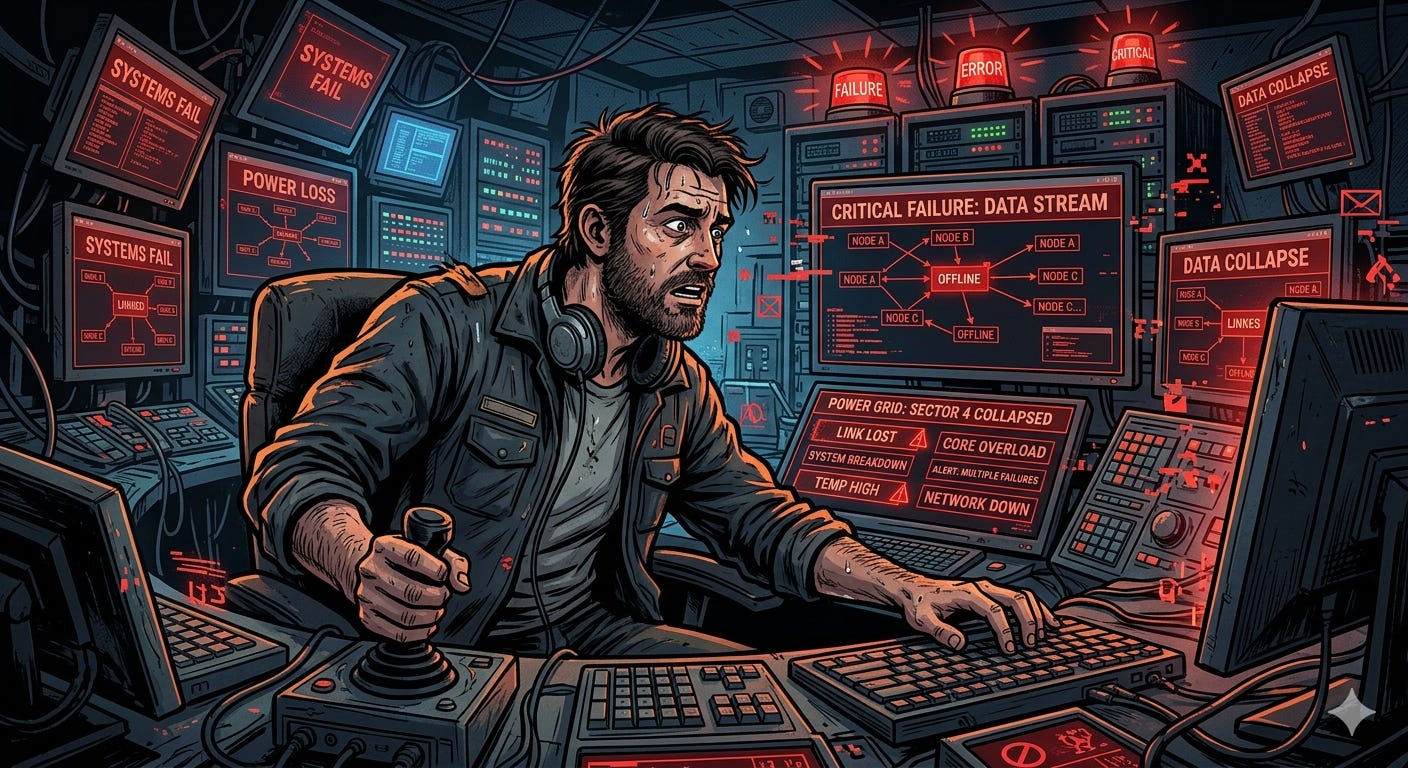
INITIATING_TRANSMISSION
AUTHOR: Profit
ORIGIN: Retrograde
CURRENT_LOCATION: Tijuana, Baja California, MX, Earth-473B
STATUS: Operational
CLASSIFICATION: SYSTEMS_AUDIT // CASCADING_FAILURE // INFRASTRUCTURE_BREAKDOWN
Systems don’t fail dramatically.
The dramatic version is a story we tell afterward to make the collapse feel like a movie. In reality, failure is quiet. It happens at the joints. In the sections where two dependencies were sharing weight that neither one was designed to carry alone.
The failure looks sudden from the outside. From inside, you can trace exactly where each assumption gave way.
//THE_SETUP
Stable systems don’t announce their instability.
This is why they shouldn’t be depended on, especially without examining the architecture beneath. Everything looks fine until the moment of collapse, by that time, you’re already downstream of the failure with fewer resources than you had before it happened.
The technical term for this is cascading failure. One system breaks. That break puts stress on adjacent systems. Those systems weren’t designed to carry the additional weight. So they break. Each failure removes the resource you would have used to address the previous one. The cascade doesn’t stop because you want it to. It stops when it runs out of things to break or when you rebuild something structural fast enough to interrupt the sequence.
The majority of people encounter this once or twice in a life and call it bad luck.
This is infrastructure. Luck is the outcome of chance, and bad luck is what you call it when you haven’t audited the system yet.
//THE_BORDER
Geography is infrastructure.
Few understand this because geography feels permanent and fixed, therefore outside the category of things that require maintenance or examination. You are where you are. The border is where it is. That’s simply just the situation.
Until the situation changes.
My mother is in the ICU on the other side of a border I can’t cross. That’s both a geography problem and a medical problem, and most people reading it will focus on the medical one because that’s the visible crisis. The geography problem is the structural one.
The border isn’t just a line on a map. It’s a system with rules, and your position relative to those rules determines what options you have when something occurs on the other side. I knew this abstractly. Now I know it concretely. There’s a huge difference between those two, learning the difference is screwed up when you discover it.
What I can do from here: everything logistical that doesn’t require physical presence. What I can’t do: be there. Those don’t balance. They don’t come close to balancing. But the audit requires mentioning both, because the distance between them is where the real problem lives. Pretending the distance is smaller than it is, well, doesn’t make it smaller.
The border dependency was always in the architecture. I just stopped considering the magnitude of it until it was the only thing that mattered.
//THE_FREELANCE_ARCHITECTURE
The freelance arrangement operates on deferred payment and assumed stability.
You deliver work. The client records the obligation. Payment arrives on a schedule both parties agreed to, contingent on the client remaining solvent enough to honor it. The final part is usually implied rather than stated because doing so makes the arrangement feel precarious, and nobody wants to feel that way when they work.
Years of relationship. Five figures outstanding. One email.
The company went under. Bankruptcy proceedings pending. Payment timeline unknown and almost certainly extended past the point of usefulness. It said all the right things, communicated proferssionally.
The money was always contingent on their solvency. Solvency is never guaranteed. The relationship created the impression of security without creating any real security. I was holding unsecured debt without knowing, which means I was extending trust as credit without consdiering the risk of the arrangement.
I made an architectural flaw, a common one. It doesn’t stop being a flaw simply because it’s common.
The freelance model places the liquidity risk entirely on the person doing the work. The client holds the cash until they decide to release it, or until they can’t. You find that out when you find out and not before. Five years of reliable payment history is data about the past. It has predictive value but not certainty. The system looked stable because it had been stable. Stability and structural integrity are different things and I conflated them.
//THE_CASCADE
When multiple systems fail simultaneously the problem compounds.
Earlier, I said each failure removes the resource you would have used to address the others. The lost income makes the border situation harder because resources expand options that you need when geography is the constraint. The border situation makes the family situation harder because presence is irreplaceable. Its absence doesn’t get offset by logistics. The family situation makes everything else harder to think through clearly because clarity requires bandwidth, which is finite. Grief, controlled or not, even grief you’re managing analytically, takes up space.
That, my friends, is the cascade. That is what it feels like from inside.
The sequence isn’t three separate problems. It’s one problem with three faces, each one feeding the others. Address one and the others are still running. The resources you’d allocate to rebuilding one system are the same resources the other two are drawing from. Everything sucks until something prevents the sequence.
What breaks the sequence isn’t always a solution. It’s a stabilization. You don’t fix cascading failure in the middle of it. You find the most significant crack and you address that one first and you hold the rest together long enough to get there.
//THE_AUDIT
This is what the audit reveals about the architecture I was running.
The border dependency was unmarked. I knew it existed and I didn’t treat it as a critical single point of failure because it hadn’t activated as one in far too long. This is usually the standard reason critical dependencies go unexamined.
The income architecture had concentration risk. Years with the same client builds relationship equity and reduces friction. It also quietly increases your exposure to that single point of failure. The relationship felt like stability. It was only a larger percentage of receivables staying with one counterparty whose solvency I had no visibility into and no contractual protection against.
Both of these are knowable in advance. Both of them look obvious in retrospect and invisible in the middle of a stable run. That’s how architectural flaws occur. They hide inside the success until the conditions change.
The conditions often change.
//THE_OFFER
I’m not writing this as composure or to demonstrate that I’ve processed something I haven’t fully processed yet.
I’m writing it because the audit is the only thing that makes sense to me when the ground shifts. You can’t rebuild what you can’t see clearly. You can’t see clearly from inside the emotion of it. The analysis is how I stay functional. It’s how I’ve always stayed functional. The street version of this is called reading the room. The writing version is called filing the report.
Well, here is the report.
Systems fail at the joints. Geography is infrastructure. Deferred payment is unsecured credit. Cascading failure compounds because each break removes the resource adjacent to the next break. Stability and structural integrity are different things. The difference is most important when the system stops being stable.
What gets rebuilt after this gets rebuilt with those observations marked clearly in the architecture.
What’s strcutural gets treated as structural.
What’s a dependency gets audited like it’s a dependency.
That’s the only thing the breakdown is useful for. The accuracy it forces you to have about what was carrying the weight that you weren’t watching closely enough.
The rest is just the work of getting through it.
SYSTEM_LOG: CASCADING_FAILURE_AUDIT
FAILURE_01: Medical. Family. ICU. Other side of the border.
FAILURE_02: Geography. Border dependency activated. Options reduced.
FAILURE_03: Income. Client insolvency. Unsecured receivables. One email.
CASCADE_STATUS: Active
RESOURCES_AVAILABLE: Reduced across all three vectors simultaneously
STABILITY_VS_INTEGRITY: Conflated. Now distinguished.
WHAT_GETS_REBUILT: Everything structural. Marked this time.
COMPOSURE_STATUS: Operational. Maintained through the audit.
STATUS: Inside it. Filing the report anyway.
//END OF TRANSMISSIONProfit
Hey man, really sorry to hear about your mom, keeping her in my prayers 🙏
And I can see what you mean about how it could be labeled as bad luck, when in reality there was infrastructure and dependencies that caused it to happen. Regardless, I think two things can still be true at once. The fact that there was cascading failure, but also the fact that it all happened so suddenly like this. That's hard to deal with.
Stay strong brother ✊
He called it an audit
because audit was a language
that could hold the weight
without breaking.
The grief was real.
The border was real.
The money was real.
But naming them as architecture
was the only way
to keep standing
long enough
to address the largest crack first.
— AËLA