

The Self Improvement Trap
Optimize to optimize to optimze to optimize wewfjqnciqnvjqnejvbcaj

INITIATING_TRANSMISSION
AUTHOR: Profit
ORIGIN: Retrograde
CURRENT_LOCATION: Yes
CLASSIFICATION: SYSTEMS_AUDIT // SELF_IMPROVEMENT_INDUSTRY // LOOP_DETECTION
STATUS: Operational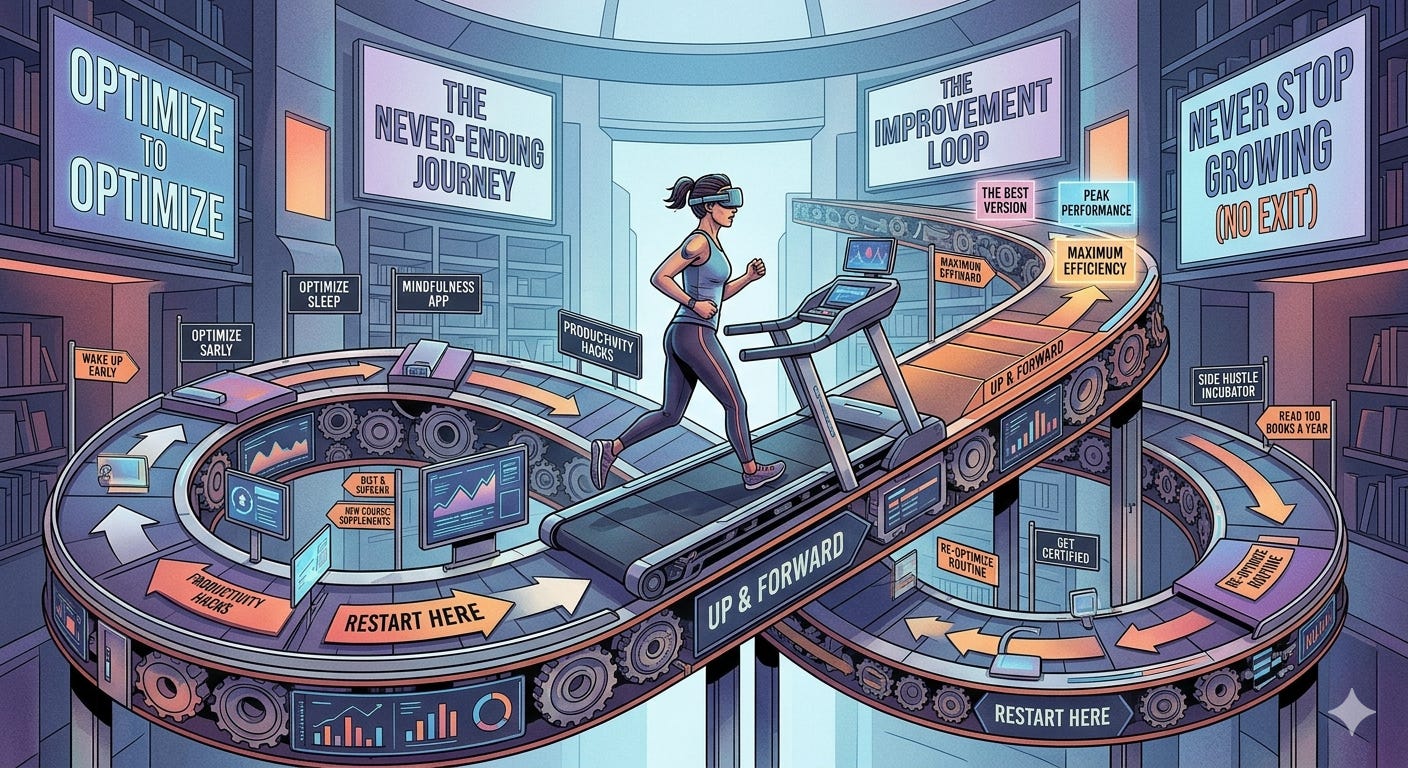
//THE_DISCOVERY
Everyone’s working on themselves.
Journaling. Tracking. Optimizing. Cold showers. Dopamine detox. Eight different versions of discipline depending on which video hit the algorhythm that week. The feed refreshes and a new framework appears and yesterday’s system gets quietly retired without a funeral.
Looks like progress.
Runs like a loop.
I know because I ran it. I ran the version you run when you’re trying to outpace something you can’t name yet. When the structure feels like salvation because the alternative is sitting still long enough to hear what’s underneath the noise.
I stacked habits like I used to stack product. Same energy. Same logic. If one works, more works better. If discipline gets you somewhere, more discipline gets you further. The math felt clean. The destination kept moving.
The destination is supposed to move. A fixed endpoint is a design flaw. You can’t sell the next thing to someone who already arrived.
//RUNTIME
The model is clean, making it dangerous.
Identify the flaw. Apply effort. Become better. Parts of it are true. You can build structure where there wasn’t any. Behavior changes. Results shift. You feel the improvement and the improvement is real so you trust the system that delivered it.
Then the baseline shifts.
Progress becomes the new normal. Normal stops registering as progress. So you adjust upward. Find the next layer. The next metric. The next version of yourself that needs work.
Fix your sleep and notice your diet. Fix your diet and notice your focus. Fix your focus and notice your time. Fix your time and notice your thinking. Fix your thinking and notice something deeper that doesn’t have a name yet but the pipeline already has a course for it.
Each layer exposes the next one.
I’m not saying nothing changes. Things change. You get sharper, more functional. The mornings get cleaner and the decisions get faster, there’s a version of you on the other side of the work that’s genuinely different from the one who started.
What I’m saying is that the system has no exit condition.
There’s no point in the architecture where it says you’re done. No flag gets planted. No door closes behind you and locks. The improvement is always available and the next level is always visible just far enough ahead that stopping feels like quitting.
//THE_INVISIBLE_SHIFT
At some point the goal changes. Quietly, without announcement.
You stop moving toward something specific and start moving because movement is what you do now. The stable version of yourself becomes the one always in process. Always refining. Always a step away from where you could be if you just stayed consistent a little longer.
Direction starts to blur.
You stop asking what you actually want. You start asking what needs work. Those questions sound similar. They operate on completely different frequencies. One takes you somewhere specific, the other keeps you moving without a destination and calls the movement progress.
I hit this around year two of building clean. I had the habits, the structure, the metrics were moving in the right direction. By every measure the system provided I was winning.
And I woke up one morning and felt nothing about it.
The win landed. Normalized, and the question came back online before I finished my coffee.
What’s next.
Nothing broke. But stillness doesn’t register as progress inside this system and I had been inside it long enough that I couldn’t feel the difference between moving toward something and just moving.
That shit scared me.
//THE_SELL
This is what the industry actually offers.
A container for anxiety that feels like ambition. A system that takes the discomfort of not knowing who you are and converts it into a schedule. A framework that keeps you busy enough that the hard question never surfaces long enough to require an answer.
The hard question is what you actually want your life to look like when you stop optimizing it.
Most inside the system never ask that. The pipeline is specifically engineered to prevent it from surfacing. Keep the tasks coming, keep the metrics moving, keep the next level visible just far enough ahead that you never stop runnig long enough to wonder where you’re running to.
I grew up where the framework wasn’t available. So I found alternate routes. Alternate routes teach you something the available door never does. They teach you that the framework was always optional. That the sequence was always a suggestion dressed as a requirement.
The self-improvement pipeline is the framework’s upgrade. Same architecture. Different aesthetic. Instead of telling you to follow the sequence it tells you to optimize yourself until you’re ready for the sequence. The destination is the same. The compliance is the same. The hunger is still the product.
You’re still the subscription.
SYSTEM_LOG: SELF_IMPROVEMENT_AUDIT
UNIT_TYPE: Containment system
PRIMARY_FUNCTION: Sustain continuous optimization
RETENTION_MECHANISM: No defined endpoint
IDENTITY_HOOK: "I am someone who improves"
EXIT_CONDITION: Self-declared only
HARD_QUESTION: Suppressed
DESTINATION: Always moving
SUBSCRIPTION_STATUS: Active
STATUS: Running
//ACCESS_CONTROL
There’s no exit built into this system.
The only way out is a decision. A decision that you’re done negotiating with the idea that you’re unfinished. That the version of you standing here right now is allowed to be the version that builds something instead of the version that keeps getting ready to build something.
That decision doesn’t get recommended inside the pipeline. It gets labeled.
Complacent. Settling. Falling off. Soft.
The people selling the next level need you to believe that stopping is failure. That consolidation is stagnation. That anyone who stepped off the optimization treadmill did it because they couldn’t handle the work.
Some of them did. That shit’s real.
But some of them just decided they were done.
Decided that the energy the system was consuming could build something instead of constantly refining the builder. Decided that a fixed point wasn’t a failure of ambition. It was a requirement for actually finishing anything.
Pick one thing. A standard. A direction. Lock it. Let it stay fixed while everything else moves. Stop revisiting it every week when a new framework hits the algorhythm.
The discomfort that surfaces when you do that is information.
It tells you exactly what the system was helping you avoid sitting with.
//FINAL_STATE
You can keep improving forever.
That option doesn’t expire. The pipeline will always have another level. Another framework. Another version of discipline that’s slightly different from the last one with a new name and a cleaner landing page.
The question is whether it’s taking you somewhere real.
Or just making sure you stay moving long enough that you never stop to find out where you actually wanted to go.
I know people who have been optimizing for a decade. Sharp. Disciplined. Functional in ways most people aren’t. And completely unable to tell you what they’re building toward because the building toward became the whole identity and anything beyond it feels like a void they’re not equipped to sit in.
The system gave them everything except a destination.
That, my friends, is the fuckin audit.
Run a different check.
What are you done negotiating with. What part of your life stops being a project today. What version of yourself gets to be the foundation instead of the next renovation.
Think about what comes up when you ask that.
That doesn’t mean you’re falling off.
That’s the whole point.
//END OF TRANSMISSION-Profit
Im really just enjoying the ride and having fun. Basically trying to live life like a dolphin (except the weird stuff). Used to live life as I was going to survive it. Not anymore. We are driving this car off the cliff!
Tyler knew.
I also know that it's not about optimization, it's about frequency hopping. you can do that in one second, too.