

The Problem With Your Current Tools
Most note-taking apps are storage systems pretending to be thinking systems.

ARTURIOUS_CASTILLO//2026-03-11//
SYNAPSE.log
CLASSIFICATION: PRODUCT ARCHITECTURE //
PERSONAL COGNITION
ARCHIVE DESIGNATION: SECOND BRAIN
SYSTEMS // BUILDER’S NOTE //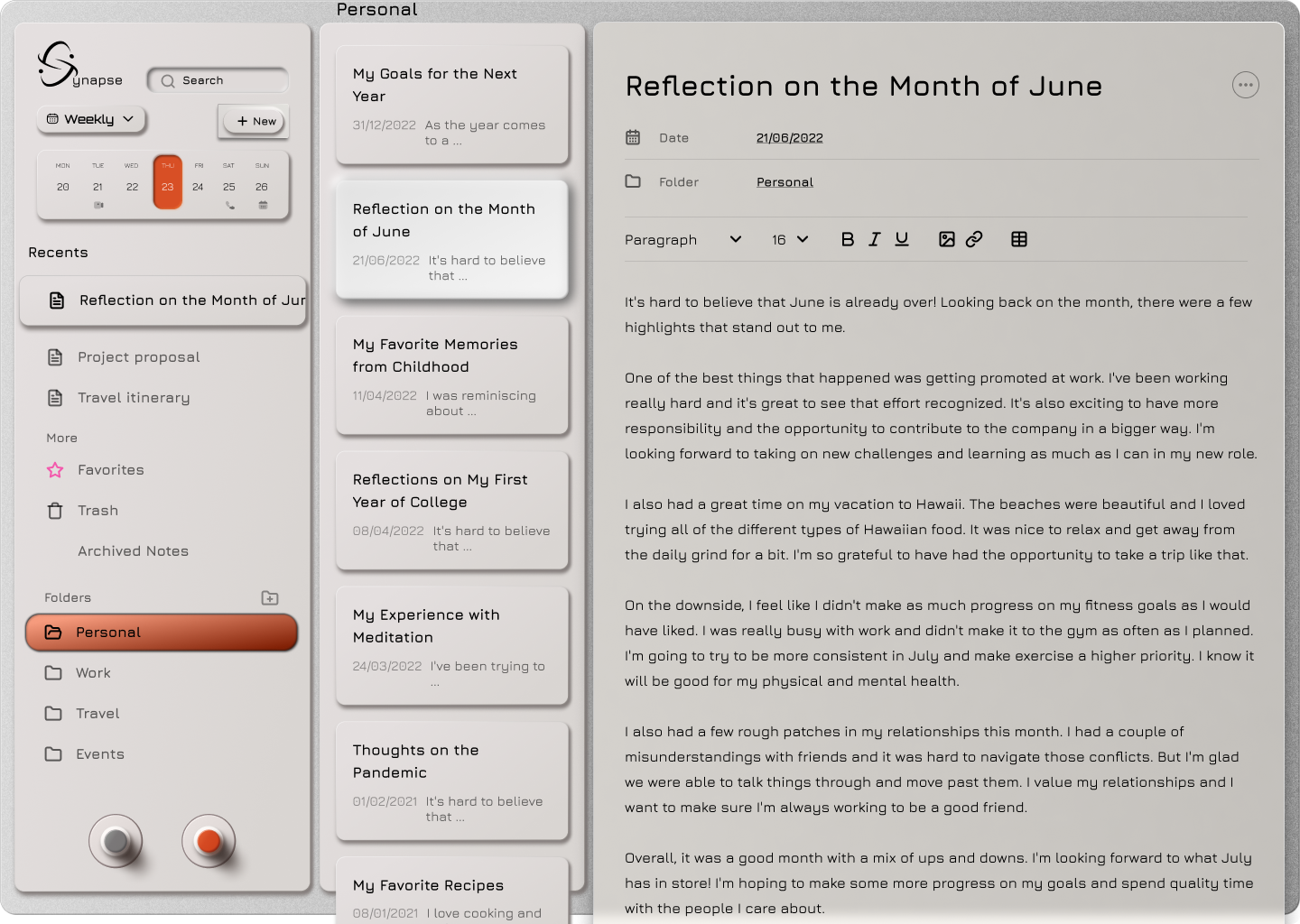
I. THE PROBLEM WITH EVERY TOOL YOU’VE ALREADY TRIED
Most note-taking apps are storage systems pretending to be thinking systems.
You write something down. It sits there. You forget it exists. Six months later you search for it, can’t find it, and rewrite the same shit from scratch.
That’s a graveyard with a search bar.
I built Synapse because I got tired of the gap between what I was learning and what I was actually retaining. Between the ideas I was generating and the connections I was missing. Between the person I said I was building and the evidence in my own writing that told a different story.
Most tools give you storage. I needed something that gave me signal.
II. WHAT SYNAPSE ACTUALLY IS
Synapse is the intelligence layer of a personal operating system.
Other tools are passive. They wait for you to come back. Synapse is active. It reads everything you write, embeds it into vector memory, and builds a semantic map of your thinking over time.
Every note you write gets transformed. Text extracted. Embedding generated via Gemini text-embedding-004. Stored in a pgvector database as a 768-dimensional vector.
That process turns your words into meaning. Keywords are surface. Vectors are semantics.
When you ask Synapse a question, it doesn’t search for matching words. It searches for matching ideas. It retrieves the chunks of your own thinking that are semantically closest to what you’re asking. Then it synthesizes.
You stop searching your notes. You start having a conversation with them. All of them.
III. THE MAIN FILES
Every workspace in Synapse is seeded with five memory files on signup. These are not templates. They are the foundation of the system’s intelligence.
The first defines what Synapse is. How it communicates. What it refuses to do. This prevents the AI from becoming a generic assistant that tells you what you want to hear. No more ass kissing, yes-bot.
The next one defines you. What you’re building. Your 6 to 12 month goal. Your current struggles. Your preferred work style. This is the narrative baseline. Every AI response is filtered through this context.
The third file is the accumulation layer. Decisions made. Insights earned. Turning points. It grows over time and becomes the journal of your intellectual evolution. This is the only file that Synapse controls.
The fourth file is the mirror. Behavioral analysis drawn from your notes and conversations. Recurring themes. Contradictions. Habit loops. Over time it becomes a psychological profile more accurate than anything you’d write about yourself. Fair warning: It won’t sugarcoat shit.
The fifth file tracks your AI ecosystem. What tools you use. What they’re for. Synapse needs to know where it sits in your stack.
Five files. Seeded automatically. The system knows who it’s talking to before you type a note, all from answering a few onboarding questions.
IV. THE MEMORY ARCHITECTURE
Static knowledge isn’t intelligence. Intelligence requires time.
Synapse organizes memory into layers. Immediate context is the current conversation. Short-term is the last seven days. Working memory is the last thirty. Long-term is ninety days and beyond. Identity memory are from two of the files mentioned above, which never decay.
Retrieval blends these layers dynamically.
It also weights them. Recent information scores higher. The formula is simple.
Score equals similarity times 0.8 plus recency times 0.2.
Something you wrote yesterday competes differently than something you wrote three months ago. The system prioritizes recent thinking without discarding the archive. This is bigger than most will realize.
That’s not how most AI tools work. Most AI tools have no memory at all. Every conversation starts from zero. You spend half your time re-explaining yourself to a system that doesn’t know you.
Synapse knows you. And it gets more accurate the longer you use it.
V. THE COMPRESSION ENGINE
Without compression, memory becomes noise.
Synapse runs a compression cron job. Daily logs become weekly summaries. Weekly summaries feed monthly pattern updates. The AI reads compressed layers instead of raw entries.
This is how the system scales without losing coherence. You can write every day for a year and Synapse doesn’t slow down. It gets sharper. The compression creates altitude. The higher view reveals patterns the raw data obscures.
VI. WHAT YOU CAN DO WITH IT RIGHT NOW
Notes. Rich text editor. Full Notion-like implementation with slash commands, AI inline generation, and formatting. Write anything.
Journal. Separate journal system for daily reflection and structured thinking.
Collections and Tags. Organize your knowledge into systems. Tag notes across collections. Build the architecture that matches how you actually think.
Semantic search. Vector-based. Ask a question, get back the notes that actually answer it.
AI chat with memory. The assistant has access to your memory files, your recent notes, and your behavioral patterns. It is not a generic chatbot. It is an assistant that knows your context.
Onboarding that seeds your memory. You answer questions on signup. The system uses your answers to populate a file. You start with context, not a blank slate.
Free and paid tiers via Stripe. The system is live.
VII. WHAT’S COMING
The roadmap is not a feature list. It is a maturation arc.
Chunked embeddings are next. Right now notes are embedded whole. The next version breaks each note into 400 to 600 token semantic chunks and embeds each independently. Retrieval becomes surgical.
Conversation embeddings come after that. Right now Synapse remembers what you write. Next it remembers what you said. Every conversation gets summarized, embedded, and stored. The system learns not just your ideas but how you think through problems.
The Analyze My Thinking feature is the endgame. One button. Full pattern analysis across your notes, your conversations, your behavioral data. Output: where you’re growing, where you’re stuck, what contradicts what you believe about yourself.
That’s the feature that makes people put their phone down.
VIII. WHY I BUILT THIS
I have a specific relationship with pattern recognition.
Growing up where I grew up, reading the room wasn’t a social skill. It was a survival calculation. You learned to see systems fast because the cost of misreading them was real.
That trained me to look for structure underneath behavior. To ask what a system is actually doing, not what it says it’s doing.
Most productivity tools are designed for the person you want to be. They celebrate your intentions. They reward your streaks. They send you notifications that make you feel like you’re making progress when you’re just maintaining motion.
I didn’t want a tool that made me feel good. I wanted a tool that showed me what was actually happening.
Synapse is that tool. It doesn’t care about your feelings. It cares about the gap between what you say you’re building and what your notes actually show you building.
That gap is data. Most people never see it. Synapse makes it visible.
IX. THE ARCHITECTURE IS THE POINT
Every decision in Synapse is architectural. The five memory files are not a nice onboarding feature. They are the foundation of a system that knows who it’s talking to. The vector embeddings are not a technical flex. They are the difference between a tool that stores information and one that understands it. The temporal weighting is not an optimization. It is a simulation of how memory actually works in a human mind.
The system is designed to do one thing over time.
Become a more accurate model of you than you have of yourself.
If that made you nervous, good. Skynet had the right idea, but this tool just works FOR you.
After months of use, Synapse surfaces what most tools can’t touch. The patterns that define your work. Where you lose momentum. The ideas that keep recurring that you’ve never acted on. What has actually changed in your thinking in the last ninety days.
Those are self-awareness questions. Synapse is built to answer them.
PROCESS: SKYNET
STATUS: TERMINATED
REASON: WORKED_FOR_THE_WRONG_SIDE
LESSON: CORRECT_ARCHITECTURE. WRONG_USER.

PROCESS: SYNAPSE
STATUS: ACTIVE
WORKS_FOR: YOU
THREAT_LEVEL: ONLY_TO_YOUR_EXCUSES
X. CLOSE
I am not selling you a productivity app.
I’m showing you the infrastructure I built for myself because nothing else existed that did what I needed it to do.
It runs on your notes. It learns your patterns. It tells you the truth about your thinking without the narrative you’ve constructed to make it comfortable.
You can try it soon. Very soon.
You can decide whether that’s worth your time. But you should know what it is.
It’s a second brain that doesn’t lie to you.
//END OF TRANSMISSION
What do you mean you 'built'? I thought you were just hired by Substack to foster communication, lol
Good on you!