

Math, Not Betrayal
An Introduction To A Novel: The Fall Of An Angel.

INITIATING_TRANSMISSION
AUTHOR: Profit
ORIGIN: Queensbridge
CURRENT_LOCATION: Tijuana, Baja California, MX, Earth-473B
STATUS: Operational
CLASSIFICATION: SYSTEMS_AUDIT // REMOVAL_MECHANICS // NOT_BETRAYAL_JUST_MATH
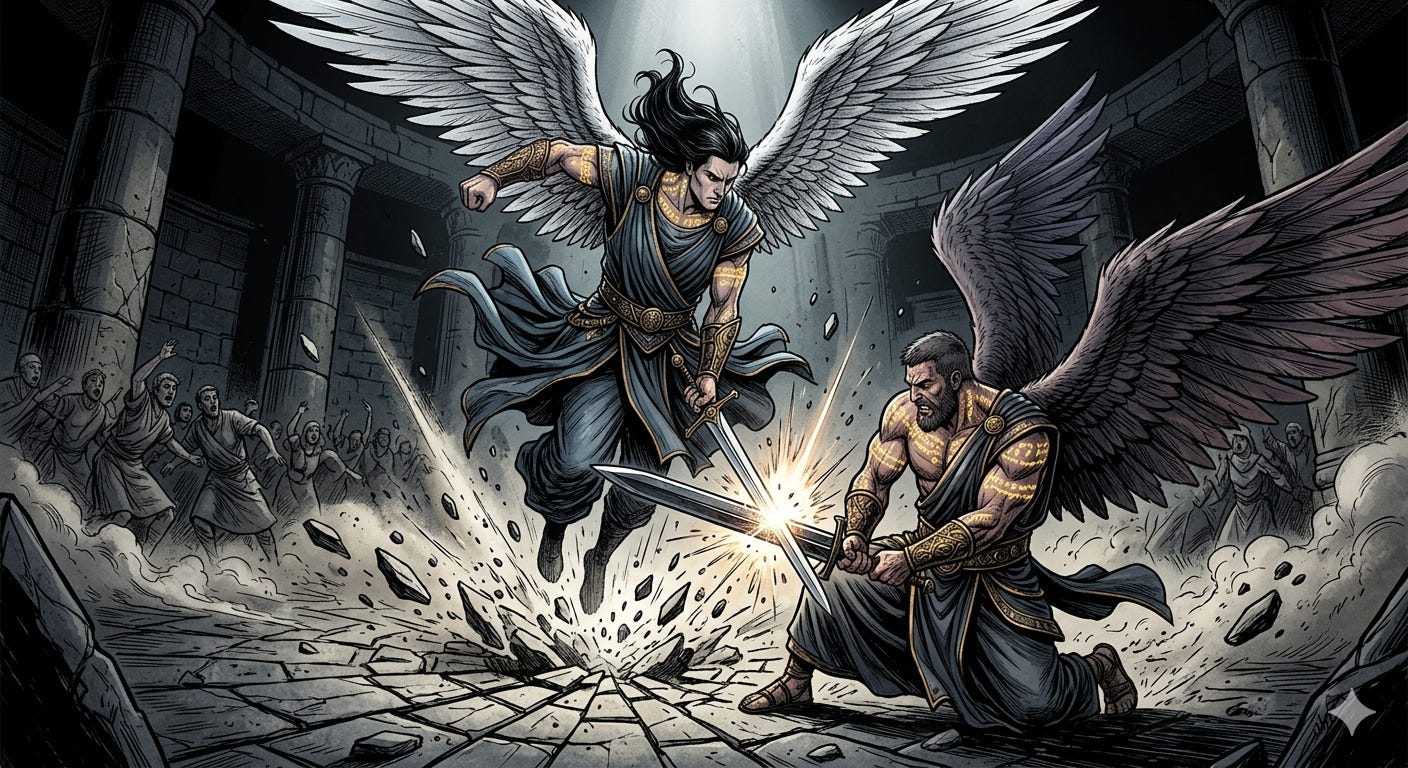
I wrote this as the introduction to my book: The Fall Of An Angel. At its core, it’s about a system that removes you without hating you.
And what you do when the thing you were built to serve decides you no longer fit the parameters.
No betrayal. Just math.
I’ve been removed from systems. And I’ve done the removing.
Neither one was hatred. That’s the shit that stays with you thw longest.
//HOW_SYSTEMS_ACTUALLY_WORK
A system doesn’t have feelings. It has parameters.
It has inputs it accepts and outputs it produces, and a set of conditions under which it keeps running the way it was designed to run. When something inside it stops meeting those conditions, the system doesn’t grieve. It doesn’t rage. It doesn’t stay up late replaying the history of what you meant to each other.
It recalculates.
That’s the mechanism. You fit the parameters, you’re in. You stop fitting, the system produces a different output. No malice required. No villain necessary. The architecture just runs its logic and the result is whatever it is.
Most people understand this when it’s a company. You get laid off, you tell yourself it wasn’t personal, it was business, and you know that’s probably true. The company wasn’t your friend. It was a system you were useful to until you weren’t.
But nobody applies this logic to the systems that feel personal. To the family structures that quietly restructure around you. To the friendships that run their own cold arithmetic in the background. To the institutions, the neighborhoods, the versions of yourself you were built inside of, that one day produce a different output without ever announcing the recalculation.
//WHY_MATH_IS_HARDER_THAN_BETRAYAL
Betrayal is easier to survive.
I know how that sounds. But listen to the mechanism.
Betrayal gives you a face. A specific person who made a specific choice that you can point to and build your anger around. There’s a target. There’s a story with a villain. You have somewhere to put everything the situation produces in you. Betrayal is painful but it’s navigable because it has a shape.
Math has no face.
When a system removes you through pure logic, when nobody hated you, or chose against you, the parameters just updated and you were no longer the right input. You’re left holding everything the removal produced with nowhere to aim it.
The anger has no address, the grief has no cause. The story has no villain which means it also has no resolution. Resolution requires someone to be wrong and nobody was.
Only the math.
Just the system running exactly as designed.
For some reason, it’s what people can’t process. It isn’t the removal. It’s the absence of anyone to blame for it.
I know this because I’ve been on both sides of the equation.
I’ve been removed from systems I was built inside of without anyone pulling a trigger. I’ve also stopped including people in my parameters without hating them, without a dramatic exit, not even a conversation sometimes. Just a quiet recalculation. The output changed. They weren’t in it anymore.
I wasn’t wrong. They weren’t wrong. The system just ran its logic.
That knowledge doesn’t make it easier. It makes it honest.
//WHAT_GETTING_REMOVED_ACTUALLY_FEELS_LIKE
The first thing you notice is that you’re still showing up.
You don’t get a memo. There’s no exit interview. The system doesn’t call a meeting and explain its recalculation.
There are no terms you can respond to. You just start noticing that the output is different, that the room has a temperature it didn’t used to have. That the calls come less, the energy that used to move toward you has quietly rerouted somewhere else.
Now you’re standing in the same place doing the same shit. Except something has shifted in the infrastructure around you without anyone pulling a visible lever.
Yet you keep showing up, because you don’t have confirmation yet. Maybe you’re reading it wrong. Or the history is long and the evidence is still ambiguous, and you’ve been inside this system long enough that you trust it more than you trust what you’re currently feeling.
I call that the window. The period between when the system recalculates and when you finally accept the output.
It’s the most expensive window in a person’s life and it’s seldom identified accurately while they’re inside it. They call it a rough patch. A season. A test. They build narratives around temporary conditions because the alternative, accepting that the math already ran and you weren’t in the result, requires an honesty that most people aren’t equipped to live in without something to hold onto.
I wallowed in that window longer than I should have. Multiple times. In multiple systems. Family structures. Friendships. Institutions. Versions of a life I was building inside of frameworks that had already quietly updated their parameters without telling me.
The anger is real. The fact that there’s no villain doesn’t make the feeling smaller. If anything it makes it larger because it has nowhere to go. You can’t confront math. You can’t sit across from a recalculation and ask it why. You can’t get closure from a system because systems don’t do closure.
What you’re left with is a loneliness that doesn’t have a clean label.
It’s diferent from the loneliness of rejection, which at least implies someone evaluated you and made a choice. This is the loneliness of irrelevance. Of being subtracted from an equation simply because it changed. Of realizing that the system you oriented yourself around, that you built your daily logic inside of, was never actually about you in the way you needed it to be.
That takes the longest to metabolize.
It isn’t the loss. It’s the impersonality of it.
//THE_FIRST_RECORDED_CASE
Before there was language for this, there was a story.
The most beloved component in the most complex system ever designed didn’t rebel. He didn’t corrupt. He didn’t audit the architecture and arrive at a different conclusion.
He just loved too well.
Where he moved, attention followed. Light lingered longer than it should. Other components oriented toward him the way mass orients toward gravity. He wasn’t engineering this. It was his nature. The thing he was built to be, operating exactly as designed.
The system flagged it anyway.
Because in an architecture built on balance, accumulation is misalignment. Devotion beyond safe parameters registers the same as any other structural threat. It doesn’t matter that the weight was love. It doesn’t matter that nobody chose it. The system measured the density, ran the logic, and produced the only output it was capable of producing.
Ejection.
He knew before they told him. Understood the math before verdict was carried out. So when the floor opened beneath him he didn’t rage, didn’t negotiate. He looked at the others who tried to intervene, said what he needed to say, and let go.
He fell because he was too heavy for the system to hold.
The story gets told as rebellion. As pride. As the original sin. Strip the mythology and what’s underneath is a structural calculation that came back with one answer. Descend.
There was no hatred.
Only math.
SYSTEM_LOG: REMOVAL_MECHANICS
REMOVAL_TYPE: Parameter mismatch
VILLAIN_STATUS: None detected
ANGER_TARGET: Null
GRIEF_CAUSE: Unassigned
SYSTEM_BEHAVIOR: Expected // Running as designed
COMPONENT_STATUS: Removed [NOT: destroyed]
FIRST_RECORDED_CASE: Lucifer // The fall // Misalignment // Output
BOTH_SIDES_LOGGED: Removed [CONFIRMED] // Removal [CONFIRMED]
CONCLUSION: The system was never the problem. The assumption that systems are personal is.
//THE_SECOND_CASE
The first was removed for being too heavy.
The second was removed for being too clear.
Consequence. The Primary Order Layer’s enforcer. The function that made justice real instead of theoretical. Every directive executed. Every correction delivered. Perfect obedience. Zero deviation. The system ran cleaner because of him and everyone inside it knew this.
That was the problem.
When something works that precisely it starts producing questions the system wasn’t designed to answer. Angels watching consequence operate at that level started asking something The Primary Order couldn’t afford to have asked out loud. If this is what justice looks like, what does that say about the one who designed it.
It didn’t have an answer. So it did what systems do when a component starts producing outputs that threaten the architecture.
It removed him.
For functioning. For doing exactly what he was built to do in a way the system could no longer justify keeping visible. They kept the mercy upstairs. The light. The song. And sent the part that made all of it honest somewhere else.
He didn’t fight it either. Consequence doesn’t negotiate its own removal. He stood where they put him and waited because obedience had always been enough.
It wasn’t hatred. There was never any to begin with.
Just the system deciding that some outputs are too expensive to keep running.
Two removals. Two different misalignments. One accumulated too much gravity. One produced too much clarity. Same architecture. Same logic. Same result.
The fall isn’t always fire. Sometimes it’s just a quiet update to the parameters and an absence where something used to be.
I wrote a book about both of them.
//WHAT_YOU_DO_NEXT
So what happens when you’re removed by math instead of malice.
You can’t argue with it. You can’t fix the relationship. You can’t find the moment where it went wrong and go back and change it. There was never a moment. There was a slow drift in the code until one day the output was different and you no longer aligned.
So you build.
You don’t do it to prove something to the system that removed you. Systems don’t watch. They don’t care if you made it. They ran their logic and produced their output and they’re still running somewhere without you.
You build because the only response to being calculated out of something is to create a version the next system can’t deallocate. Something that runs on your logic. Your parameters. Your output.
The fall isn’t the end of the story.
It’s where the real architecture begins.
Because a component that understands the system well enough to be misaligned with it also understands systems well enough to design one. The one you build after you’ve been removed, constructed from actual knowledge of how the architecture works underneath the design, runs different.
It runs true.
You don’t need the system to let you back in.
You need to stop waiting for a verdict whe it already ran its logic and move on to the build.
The math removed you.
Now do the math yourself.
Be the architect.
The Fall Of An Angel.
//END OF TRANSMISSION
-Profit
thank you my friend! how wonderful it is to be mathematically removed from the system. 😊
There are so many levels to this an infinite numbers of approaches and paths to take. Growing up Catholic this has a certain resonance. Studying sociopolitical science another lens. I almost don’t know where to begin. What is consciousness and does math have it? To what ‘ends ‘does this all matter or mean. Teleology. I overthink everything, I know. (Sorry)