

How Much Can You Know About Yourself If You’ve Never Gotten Into A Fight?!
A Note That Became An Essay.

INITIATING_TRANSMISSION
AUTHOR: Profit
ORIGIN: Queensbridge
CURRENT_LOCATION: Tijuana, Baja California, MX, Earth-473B
STATUS: Operational
CLASSIFICATION: SYSTEMS_AUDIT // THE_STREETS // WHAT_A_STREET_FIGHT_TEACHES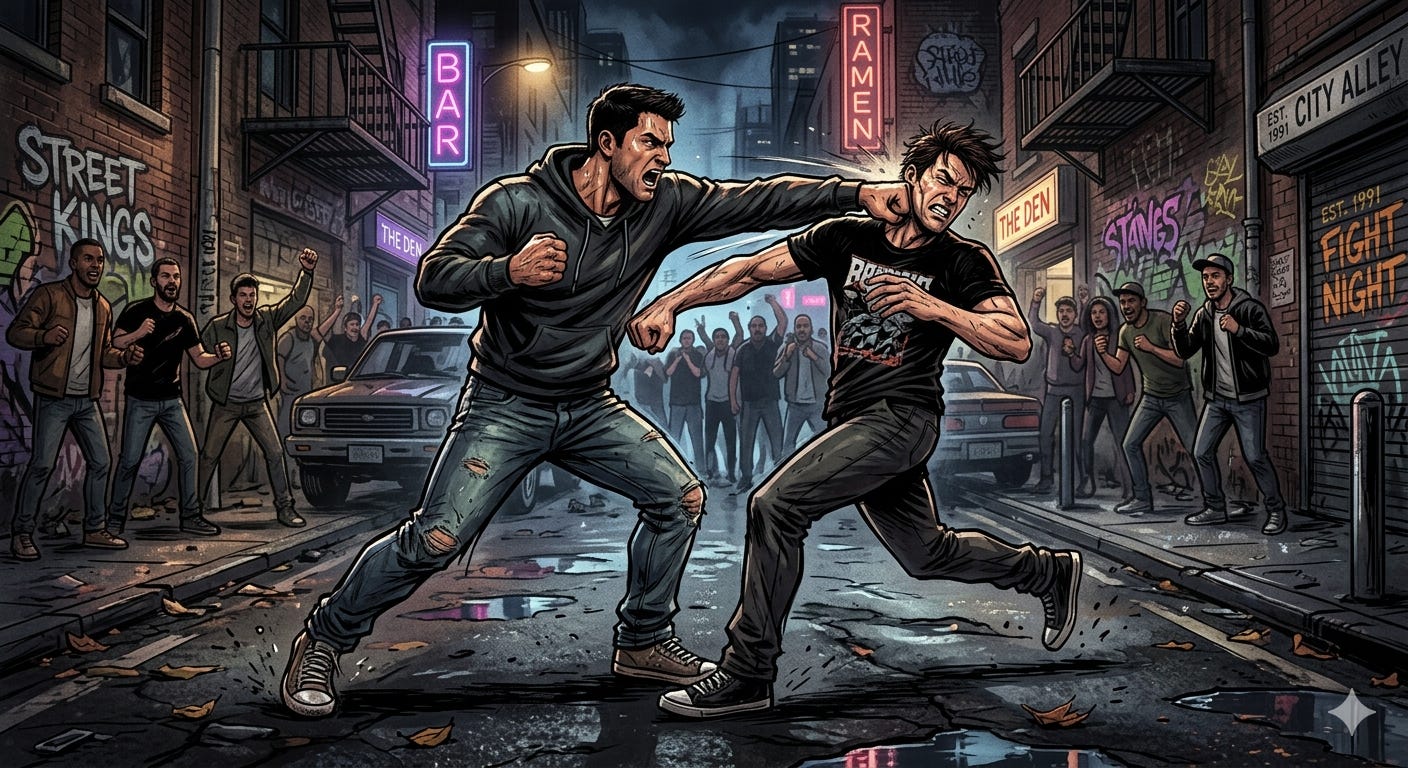
Most people have never met themselves.
They’ve met the version of themselves that exists when everything is fine. The version that functions in comfort, performs well under mild inconvenience, and believes its own press.
That version is well-dressed. Reasonable. Has opinions on podcasts and a five-year plan.
That version is a draft.
I don’t mean fighting as a hobby, boxing class or MMA where the rules are posted on the wall and everyone goes home after. I’m talking about a fight that finds you, or the kind you can’t avoid, the one where no referee exists and nobody is keeping score except your nervous system.
I mean the moment when something is genuinely trying to fold you, and you find out, in real time, whether you fold.
Most people have never been there. Most people don’t realize what that costs them.
//SAFE_MODE
There’s a concept in systems engineering called a stress test. You don’t find out what a structure can hold by looking at it. You find out by loading it until something gives. Engineers do this on purpose, they need to know where the failure point is before the bridge has cars on it.
Most people go their entire lives without ever running a stress test.
They build a self-image from favorable conditions. From environments where they set the terms, where the opposition is manageable, and they can exit when it gets uncomfortable.
Then they mistake that accumulated comfort for self-knowledge. They say things like “I know who I am” as if identity is something you discover at rest.
I don’t think it is.
Identity is structural. You don’t know if it holds until something’s pushing against it. You can’t know your own tensile strength until something applies tension. The self-knowledge most people carry is theoretical, a model built from untested assumptions about how they’d respond to pressure they’ve never actually faced.
I learned this shit the hard way. Multiple times. In too many zip codes.
//WHAT_THE_STREETS_TEACH_YOU
I grew up in a place that has produced more than its share of legends, cautionary tales, and people who had to figure out early on who they really were.
The first thing a fight teaches you is how your mind lies to you constantly.
Before you’ve been in one, you have a story about how you’d respond. You’d be calm. You’d be strategic. You’d do what needed to be done and walk away clean. The story feels true because you’ve never stress-tested it. The second something actually happens, when the adrenaline hits and time does that strange elastic thing it does and someone’s face is in yours and the situation is real, that story either holds or it doesn’t.
The first time, for most people, it doesn’t.
This isn’t becasue they’re cowards. They’ve just never felt that specific fear before, never operated under that kind of cognitive load. They haven’t had to make decisions when their hands are shaking, their ears are ringing and every training simulation their imagination ran was missing the most important variable: actual consequence.
The streets don’t grade on a curve. There’s no participation trophy for good intentions. What you are in that moment is what you are.
That revelation, however it hits, is irreplaceable.
//THE_FRIEND_ISSUE
Deano Symeonides mentioned something in the comments that deserves its own section: you learn a lot about who’s a real friend.
He’s right, and this one smacks harder than the physical lesson.
Crisis sorts people with a precision that years of friendship can’t replicate. When something goes wrong, really wrong, you find out immediately who stays, who disappears, who tells the story afterward in a way that centers themselves, and who was there before anyone knew how it ended.
I’ve had people I ate with weekly vanish when the situation wasn’t safe to be associated with. I’ve had people I barely knew step into something they had no obligation to enter. The math doesn’t care about history. It doesn’t care about how long you’ve known each other or how many laughs you’ve had. It runs in real time, and it is ruthlessly accurate.
You can’t bullshit your way through a genuine crisis. To me, that means crises are the only reliable filter.
Comfort reveals nothing. Crisis reveals everything.
If you’ve never been in a real situation, never needed people in a way that cost them something to show up, you don’t actually know who’s in your corner. You have suspects, not certainties. You have relationships that have never been tested and therefore can’t be trusted the way tested ones can.
I’m not pessimistic, I’m an engineer. You don’t put unverified components in critical systems.
//WHAT_FEAR_TEACHES_YOU
A lot of people will say: okay, but you can learn about yourself in other ways. Under career pressure. Under relationship pressure. Under financial stress.
And that’s true. Partly.
But fear of physical harm is a different animal. It strips away processing layers that other kinds of pressure leave intact. When the stakes are your body, when something could actually damage you permanently, the access it gives you to your unfiltered self is unlike any other situation.
Your body doesn’t philosophize. It doesn’t negotiate. It responds. How it responds, whether you go cold and clear or whether you freeze and dissociate. Or if your instinct is to protect someone else or pull back, whether the fear makes you sharper or collapses your thinking entirely, that’s data you can’t get any other way.
I’ve seen people I thought were stone-cold discover they go very quiet and very still under real pressure. From a depth of calm they didn’t know they had. Some people who talked the loudest discover their wiring wasn’t what they advertised. I’ve also seen people who would describe themselves as soft produce something in a situation that nobody in the room expected.
None of them knew. Until they knew.
//THE_OUTCOME
Once you’ve been through something real, been genuinely tested and come out the other side with data about yourself, the way you move through the world changes. It isn’t because you’re tougher in some cinematic sense. It’s because you’re no longer operating on assumptions.
You know what you did, what you felt. You know what held and what didn’t. That knowledge, however uncomfortable it is, becomes the actual foundation of your self-image instead of the constructed one.
People who’ve been tested carry a different kind of quiet. They don’t need to convince anyone of anything because they’re not trying to convince themselves. The ones who perform the most, who are loudest about what they’d do, most invested in their own mythology, those are almost always people who’ve never had their story checked.
I’m not saying everyone needs to have been in a street fight. I’m saying everyone should find their equivalent, the situation that strips the narrative away and shows you what’s underneath. The pressure that can’t be managed from a distance or processed after the fact at a safe remove. The situation that happens to you, with real stakes, and you either handle it or you don’t.
Until that happens, you’re running on theory.
And theory, no matter how sophisticated, isn’t knowing.
//SYSTEM_LOG
STRESS_TEST_RESULTS: Most never run one
SELF_IMAGE_SOURCE: Favorable conditions [UNVERIFIED]
FEAR_RESPONSE_TYPE: Variable // Not selectable
FRIENDSHIP_FILTER: Crisis [MOST_ACCURATE] // Comfort [UNRELIABLE]
IDENTITY_STATUS: Theoretical until loaded
KNOWN_VARIABLES: Calm under pressure [CONFIRMED] // Pride override [CONFIRMED]
UNKNOWN_VARIABLES: Everything else // Until the situation runs
//HONEST_INVENTORY
I know things about myself now that took getting hit to learn.
I know I go calm when it matters. The volume in my head goes down. I’ve been in situations where everyone around me was escalating and something in me just… leveled.
I’m not fearless, the fear apparently routes somewhere useful in me instead of somewhere paralyzing. I didn’t choose that. I found it.
I also know I have a pride problem that’s gotten me into situations I could’ve walked away from. There’s a version of me that will let things escalate past the point of reason because something in the wiring reads retreat as loss before it reads it as strategy. I know it now because it’s shown itself in real scenarios, cost me real things, and left real evidence I couldn’t argue with.
Both of those things are me. The calm under pressure and the pride that overrides judgment. I couldn’t have told you either one from theory alone.
No one has ever asked me, and I’m grateful for that. I got locked up for beating a dude within an inch of his life. A loud dude, who talked the talk, and decided to talk shit about my very recently deceased father. Attempted murder. For a street fight.
//THE_QUESTION_IS_THE_POINT
How much can you know about yourself if you’ve never gotten into a fight?
The answer is: enough to function. Probably enough to appear self-aware in most conversations. Enough to build a story you mostly believe.
But not enough to know what you actually are when something real is at stake. Not enough to know who shows up when the performance is no longer sustainable. Not enough to trust yourself in the situations that matter most, because you’ve never seen yourself there.
The fight, the literal one, the metaphorical one, whatever form it takes for you, is not the point. The point is the data it produces. The point is what you learn about yourself that no amount of comfort, no amount of reflection, no amount of journaling in soft lighting can ever teach you.
The self is not a fixed thing you discover by looking inward.
It’s a system you can only understand by running it under load.
//END OF TRANSMISSION-Profit
I was in a hostage situation. I opted to stay and distract the guy by talking to him for almost two hours so everyone else could stay safe until the police got there. But I spent the next two years on cycles of benzos and zoplicone because I couldn’t sleep anymore. Swings and roundabouts, I guess. Good under pressure, big come down after pressure.
This was an amazing read. Loved your take on this. Some think they'll become Jason Statham and whip everyone to the ground, others fear the fear they'll feel when in a fight, and others just don't know, because the 'world' of fights and so on is so far removed from their everyday life and their journey so far.
At the end of the day, it's so hard to predict how each person will react in a fight. I've seen some quiet ones, who might be described as shy or even weak by some people, completely seem to tune in and plant both feet firm on the ground. The outcome of the fight is not important.
It's very interesting to see these different sides of people, based on the context. So, in corporate, a shy person will at some point be described as weak. But in a fight, they may be more brutal that anyone will ever know. And the arrogant, toxic employees, when in a fight might be devoid of all it takes to stand there and deal with a situation.
Sorry, man, rambling on. But this topic has sparked something in me.
For me, it always felt like I was a magnet for fights. Like people would see something on/in me and decide I was fair play. I never had to go looking for one. They found me.
Thanks for the mention, also. Appreciate it.