

Conditional Agency
The Third Option.

INITIATING_TRANSMISSION
AUTHOR: Profit
ORIGIN: Yes
CURRENT_LOCATION: Tijuana, Baja California, MX, Earth-473B
STATUS: Operational
CLASSIFICATION: SYSTEM_AUDIT // AGENCY // THE_THIRD_OPTION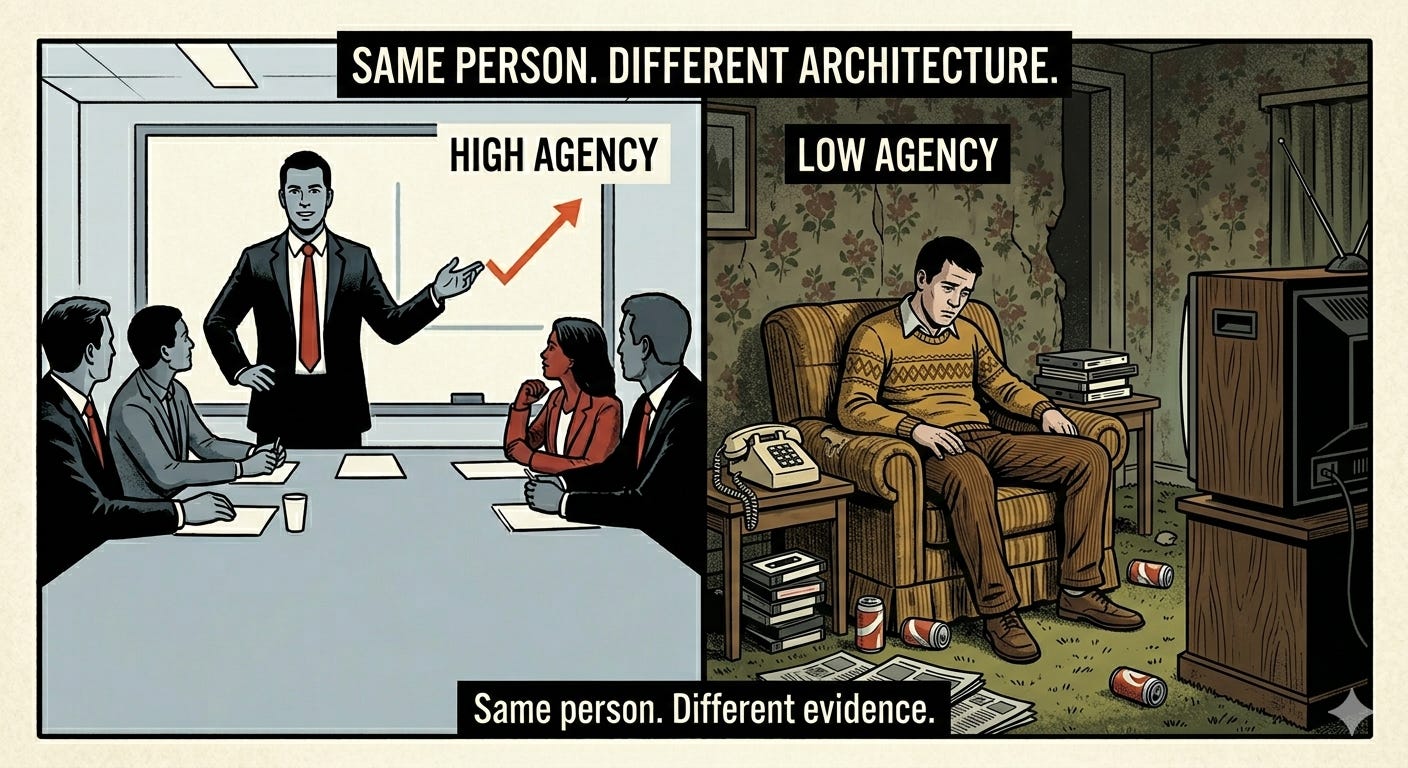
I read an article by Just Shawn recently, who red a note by Kpaxs. Which lead to this.
High agency. Low agency.
Pick one.
That’s what they give you. Two buckets, a binary, clean enough to fit on a slide deck and sell in a course for $297. The productivity crowd pushes this one constantly. The self-help pipeline turned it into a personality judgment. You’re either someone who takes ownership of outcomes or you’re someone who hands them to circumstance and calls it a life.
The problem I see here is the instruction.
//THE_SETUP
Agency isn’t a fixed trait. It’s a pattern that got calibrated by specific environments over time. The man who built a company from nothing but won’t leave the block he grew up on. The woman who negotiates everything at work but can’t hold a single boundary at home. High in one room. Low in another. Same person. Different architecture. Different evidence.
The framework doesn’t have an option for that. So it files them wrong and tells them to think differently.
This seems to be the norm these days.
//THE_THIRD_OPTION
Conditional agency.
You’re not low agency because you lack belief in your own capacity. You’re low in specific domains because the environment taught you, accurately and repeatedly, that action in those domains doesn’t change the outcome. You tested it. It failed. You stopped sending input. You filed the result and moved on.
I wouldn’t consider that a mindset problem. It’s a reasonable response to real data.
The man at zero doesn’t take risks because he understands the math. He’s already operating at the edge of what’s survivable. The framework calls that loss aversion and labels it irrational. The streets call it knowing your margin. They’re describing the same behavior from opposite sides of the same building, and only one of them has ever been inside it.
This is where the framework can fuck people up. It looks at the result of the environment and diagnoses the person. It sees protective behavior and calls it broken code. It sees caution and calls it fear. It never asks what produced the behavior before it starts recommending replacements for it.
//THE_ONES_WHO_STAY
There’s also a version of this that goes the opposite. It’s also worth auditing separately.
Some people are sitting in conditional low agency in rooms where the ceiling is actually gone. The environment changed. The constraints lifted. The system that originally made action pointless stopped running years ago. But the read didn’t update. They’re still filing results from a test they ran in a room that no longer exists, in a situation that has nothing to do with where they’re standing right now.
That’s different from the man at zero. That person has margin. They have options. The low agency read in their case isn’t survival arithmetic. It’s old code running on current hardware.
Telling both of them the same thing is the framework’s biggest failure. One needs the environment addressed. The other needs the map updated. Prescribing mindset shifts to the first one is lazy. Prescribing structural analysis to the second is cowardice dressed up as empathy.
//THE_SOCIAL_INFRASTRUCTURE
This is what seems to be skipped completely.
Agency doesn’t operate in a vacuum. It operates inside relationships. And the people around you have a vested interest in your range of action staying predictable. The moment you start acting with more agency in domains where you previously didn’t, the environment pushes back. Not always loudly. Usually quietly. Through friction, through discomfort, through the slow withdrawal of approval from people who benefited from the version of you that didn’t push.
The framework treats agency as a purely internal phenomenon. A belief, a mindset. Something you fix inside your own head and then carry into the world.
It’s not. The people in your life are part of the infrastructure. The relationships you’re in are part of the system. You can update every internal read you have and still find the external architecture actively working against the new behavior. That’s a system protecting its own stability by resisting the change in one of its components.
The cost of shifting domains isn’t just psychological. It’s social. And most people don’t make it through that part not because they lacked the internal work but because the external friction was real and they were doing it alone.
//THE_SHIFT
What it actually takes to move from conditional to high in a domain that’s been low isn’t a mindset adjustment. It’s a test.
You have to send input into the room again. You may not even know if it will work. But it’s the only way to find out if the ceiling is structural or old data is to push on it and see what happens. That requires margin. It requires enough safety to absorb a failure that might just be confirming what you already believed. Most people don’t have that margin and the framework never asks whether they do before telling them to take more risks.
The shift is available to people who can afford to run the experiment. For everyone else the prescription is the same but the infrastructure to execute it isn’t there. Knowing that difference is the real audit.
SYSTEM_LOG: AGENCY_AUDIT
BINARY_MODEL: High / Low. Clean. Incomplete.
THIRD_STATE: Conditional. Domain-specific. Calibrated by evidence not character.
LOW_AGENCY_READ: Usually accurate at time of formation.
OLD_CODE: Same read. Different room. Update required.
THE_SOCIAL_LAYER: People in your life are infrastructure. Behavior change has a social cost.
SURVIVAL_ARITHMETIC: Caution at zero is math not fear.
HIGH_AGENCY_TELL: Often a wider playing field not a superior psychology.
THE_SHIFT: Requires margin. Most frameworks skip that part.
STATUS: Still testing.
//THE_OFFER
The framework gives you two lanes and tells you to pick the better one.
The audit gives you something more useful.
Map the domains. Figure out where you’re running high and where you’re running low. Then ask two questions. First: is the ceiling in that room structural or is it old data running on current hardware. B: do you have the margin to run the experiment that would tell you which one it is.
If the ceiling is structural, the move is to address the environment, not the mindset. If it’s old data, the move is to update the read. If you don’t have the margin to test it either way, that’s the actual constraint and no amount of agency reframing solves for a resource problem.
Some people are trapped. Some people are convinced they are. Both look identical from the outside. The difference lives in the architecture.
That distinction is the thing the binary model was never built to make.
Thug Life.
//END OF TRANSMISSION
Profit
Excellent.
scaling ceilings| por vida| thug life ⚔︎⚔︎